

That £450 laptop on a flash sale looks like a bargain until you're waiting three minutes for Outlook to open. For a small business, a cheap computer isn't a saving, it's a daily tax on your time. Here's what actually matters when you buy your next machine.
A computer under £500 usually gets there by using a low-powered processor, 8GB of RAM (sometimes less) and a small, slow drive. On paper it says "Intel Core i5" or "Ryzen 5", but it's often a cut-down version with fewer cores and lower clock speeds than the same name in a proper business machine.
You feel it in small ways that add up. Windows takes longer to boot. Teams calls stutter. Ten browser tabs and Excel start swapping to disk. Over a three-year life, that's hours of lost productivity per person, plus the cost of replacing the machine sooner because it can't keep up.
Cheap machines also tend to have plastic hinges, non-replaceable batteries and limited ports. They aren't built to be repaired, so when something fails you replace the whole thing rather than a part. That's not a saving, it's a subscription to frustration.
If you already have machines like this, a PC health check can tell you whether an upgrade or a replacement makes more sense.
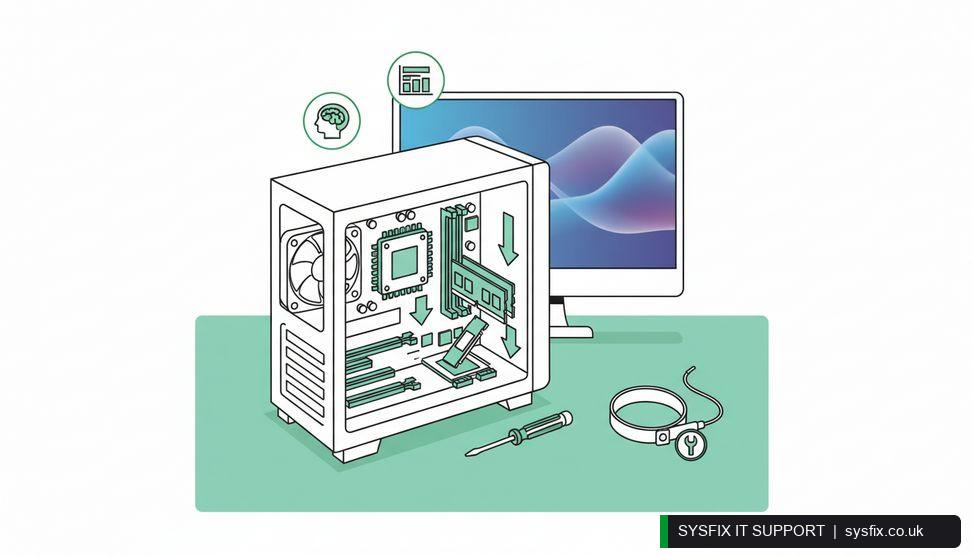
Intel's Core naming is a rough guide to how many cores and threads you get, and how hard the chip can work before it slows down.
The generation matters too. A 12th-gen i5 can beat an older i7. Always check the model number, not just the badge. AMD's Ryzen 5, 7 and 9 follow a similar pattern.
Chromebooks are a different story. They run ChromeOS, which is built around the browser. Many Windows and Mac business apps simply don't run on them, local storage is tiny, and they're designed to be disposable. For a small business that needs Office, accounting software or line-of-business apps, they're a poor fit.
In 2026, 16GB of RAM should be your minimum for any business machine. Windows itself, Teams, a browser with a dozen tabs and Office will happily use 10–12GB before you've done anything demanding. With 8GB you're constantly paging to disk, which is why the machine feels slow even when the processor is fine.
Go to 32GB if you work with large spreadsheets, virtual machines, CAD or Photoshop. RAM is one of the few upgrades worth paying for up front, because it's often soldered in on thin laptops.
Storage is the other trap. A 256GB SSD sounds generous until you install Windows, Office, Teams, a couple of line-of-business apps and your own files. Add a year of photos, downloads and Windows updates and you're juggling free space. 512GB is a realistic minimum; 1TB is comfortable. Always choose an SSD over a mechanical hard drive, and check whether the drive is upgradeable.
There's no single "best computer". There's the right computer for the work.
CAD and Photoshop are demanding because they work in real time with large files, layers, meshes and renders. They lean on the processor, the graphics card, RAM and fast storage all at once. Skimp on any one of those and the whole machine feels broken.
If you'd rather not guess, we can build a custom PC for work that matches your actual software and workflow, rather than a spec sheet.
The cheapest machine is rarely the cheapest to own. A well-specced business computer lasts four to five years, holds its performance, and can often be upgraded rather than replaced. A sub-£500 machine often needs replacing in two.
Before you buy, list the software you actually run, how many browser tabs and apps are open at once, and whether you'll ever need to edit photos, video or CAD files. That list tells you the processor, RAM and storage you need.
We source computers built for your needs, set them up, migrate your data and keep them running. If you'd like a machine that just works, an IT support contract covers sourcing, setup and ongoing support in one place.
You can also read more about how upgrading to a new computer can boost your mental health — a slow machine is a daily source of low-grade stress most people don't notice until it's gone.
We'll recommend, source and set up the right machine for your team, then keep it running. Get in touch and we'll take the guesswork out of your next purchase.
Explore IT support contracts → Book a FREE IT Consultation →Related services: PC health check · IT support packages · remote IT support
When you subscribe to the blog, we will send you an e-mail when there are new updates on the site so you wouldn't miss them.
© SysFix IT Support Ltd, 2003-2026
VAT Number: GB 206 7821 12
Company Number: 09416191